Quantization Documentation
Quantization Workflow
 avatar
Output Precision and Scale Acquisition
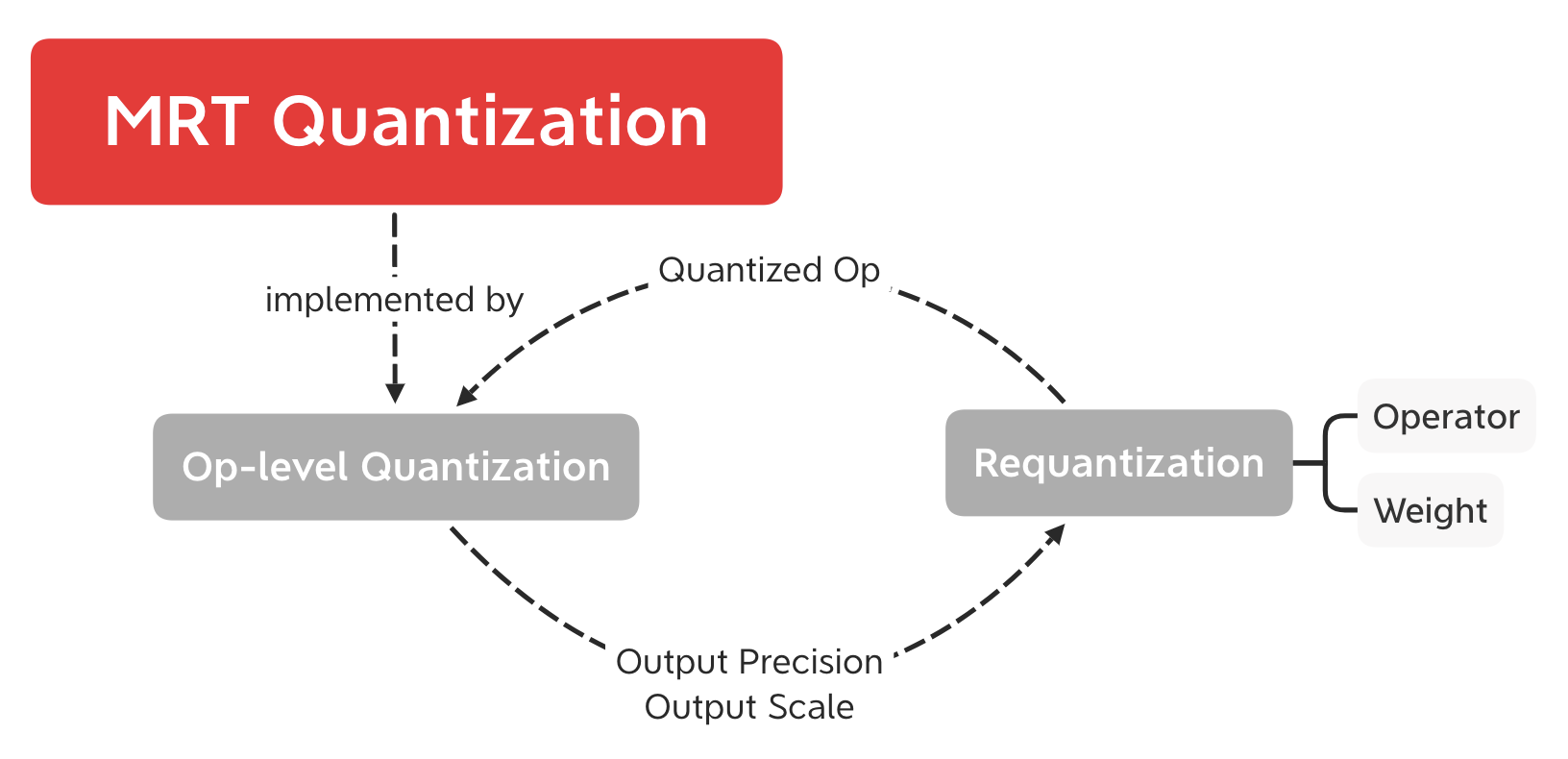
MRT Op-level quantization procedure is defined in quantize method of Transformer defined in tfm_base.py, the inheretances of which implement the quantize method (defined in tfm_ops.py), where the oprec (output precision) and oscale (output scale) (for some cases) is obtained for each operator.
For example, the core python code of the quantization of Convolution is listed as follows.
oprec = kwargs['op_input_precs'][op_name]
X, xprec, xs = requant_operator(childs[0], oprec, oname=name, **kwargs)
W, wprec, ws = requant_parameter(cns[1], oprec, oname=name, **kwargs)
B, bprec = None, None
if not get_attr(attr, 'no_bias', False):
    bs = ws * xs
    bias_prec = get_bit(th_dict[cns[2]] * bs)
    B, bprec, _ = requant_parameter(
        cns[2], bias_prec, bs, oname=name, **kwargs)
scales[name] = ws * xs
op = get_mxnet_op(op_name)(X, W, B, **attr, name=name)

shp = kwargs['params'][childs[1].attr('name')].shape
k = int(nd.prod(nd_array(shp[1:])).asscalar())
kprec = get_bit_cnt(k)
infer_prec = kprec + xprec + wprec
if not get_attr(attr, 'no_bias', False):
    infer_prec = max(infer_prec, bprec) + 1
kwargs['precs'][name][OUT_KEY] = infer_prec
Operator or Weight Quantization
The operator or weight quantization is realized requant method defined in tfm_utils.py, where the properly specified oprec (and oscale if necessary) will be taken as input parameters.
Weight is directory quantized from floating point values to int values by int_realize method. The core python code of weight quantization is listed as follows.
if th_dict[wname] == 0:
    oprec, oscale = 1, 1
    shp = params[wname].shape
    params[Wn] = sutils.nd_zeros(shp)
    attr = {'precision': '1'}
    W = mx.sym.var(Wn, shape=shp, attr=attr)
else:
    oprec = kwargs['precs'][wname].get(kwargs['oname'], oprec)
    oscale = oscale if oscale else scale(th_dict[wname], oprec)
    params[Wn] = sim.int_realize(
        params[wname].astype("float64") * oscale,
        oprec, logger=logger)
    attr = {'precision': str(oprec)}
    max_v = params[Wn].abs().max().asscalar()
    range_v = (2**(oprec-1)-1)
    assert max_v <= range_v
    W = mx.sym.var(Wn, shape=params[Wn].shape, attr=attr)
While for operators, we could take the output of the former layer as the int-realized input data of the current layer to be quantized. this input data is within the precision range of iprec stored in the dict precsand output scales of the former layer are lazily in the dict scales. Therefore, the input should be requantized, which means that the rescale (scale-iscale ratio) need to be calculated. The core python code of operator quantization is listed as follows.
if th_dict[xn] == 0:
    return X, 1, oscale if oscale else 1

exactly = True if oscale else False
oprec = precs[xn].get(kwargs['oname'], oprec)
oscale = oscale if oscale else scale(th_dict[xn], oprec)
iscale = kwargs['scales'][xn]
iprec = precs[xn][OUT_KEY]

sb = get_bit(th_dict[xn]*iscale) - oprec
if sb > shift_bits:
    iprec -= sb
    X = realize(X, sb, iprec)
    iscale = iscale / (2**sb)

if exactly or iprec > oprec:
    rescale = oscale / iscale
    bits = MAX_BIT - iprec
    frac, exp = sim.cvm_float(rescale, bits)
    sim_scale = frac * (2 ** exp)
    scale_err = abs((sim_scale - rescale) / rescale)
    if scale_err > 0.001:
        logger.warn(
            "Operator  %-20s name=%-40s quantize with sb=%s" +
            " scale=%s, error=%s",
            xopn, xn, sb, iscale, scale_err)
    oscale = iscale * frac * (2 ** exp)
    if frac > 1:
        var = sutils.nd_const(frac, graph, params)
        X = mx.sym.broadcast_mul(X, var, name=N.n("mrt_quantize_scale"))
    X = realize(X, -exp, oprec)
else:
    oscale = iscale